FILE 03 / TWO PHYSICAL SOURCES
Two objects.
2701 / 1297
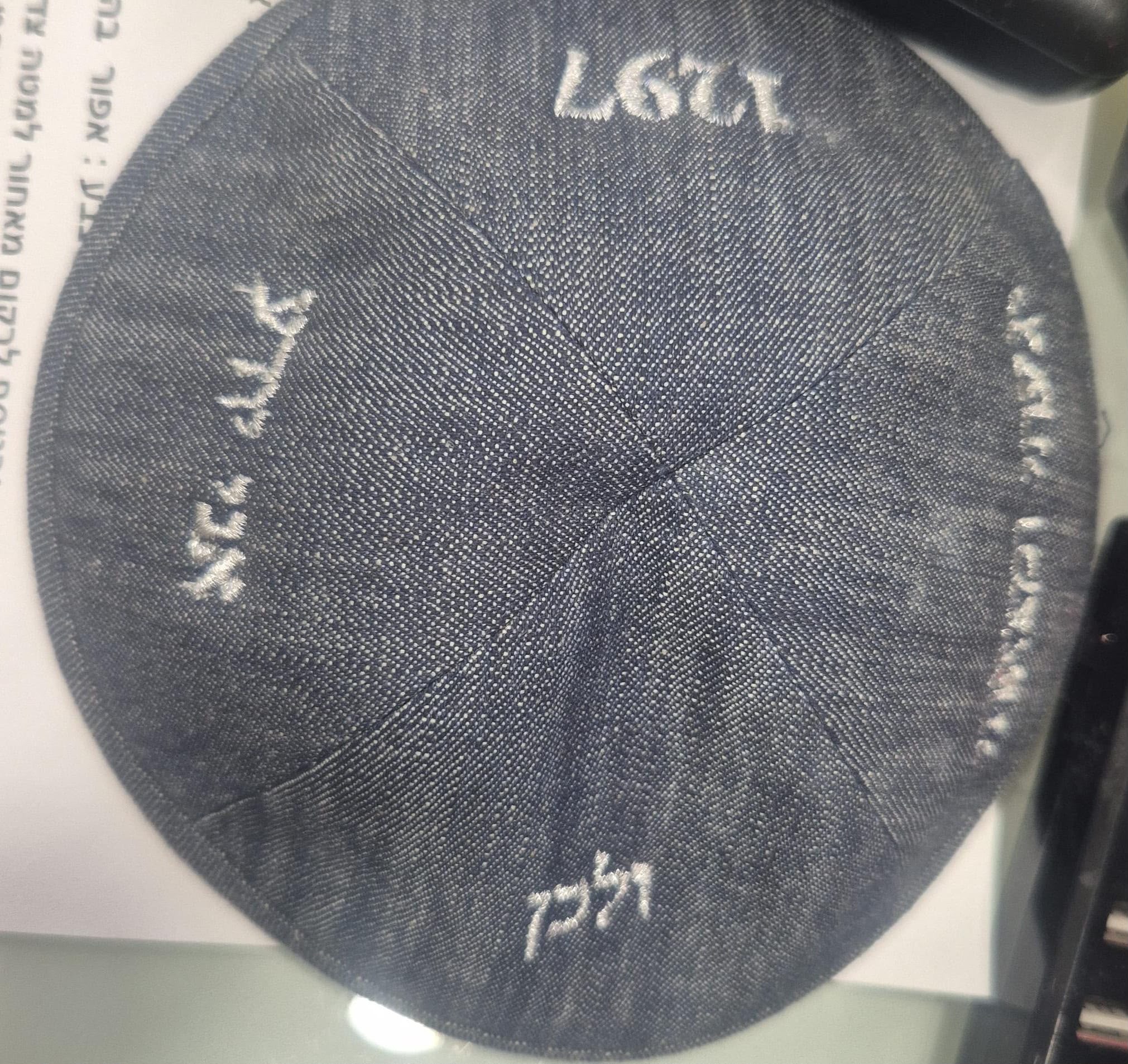
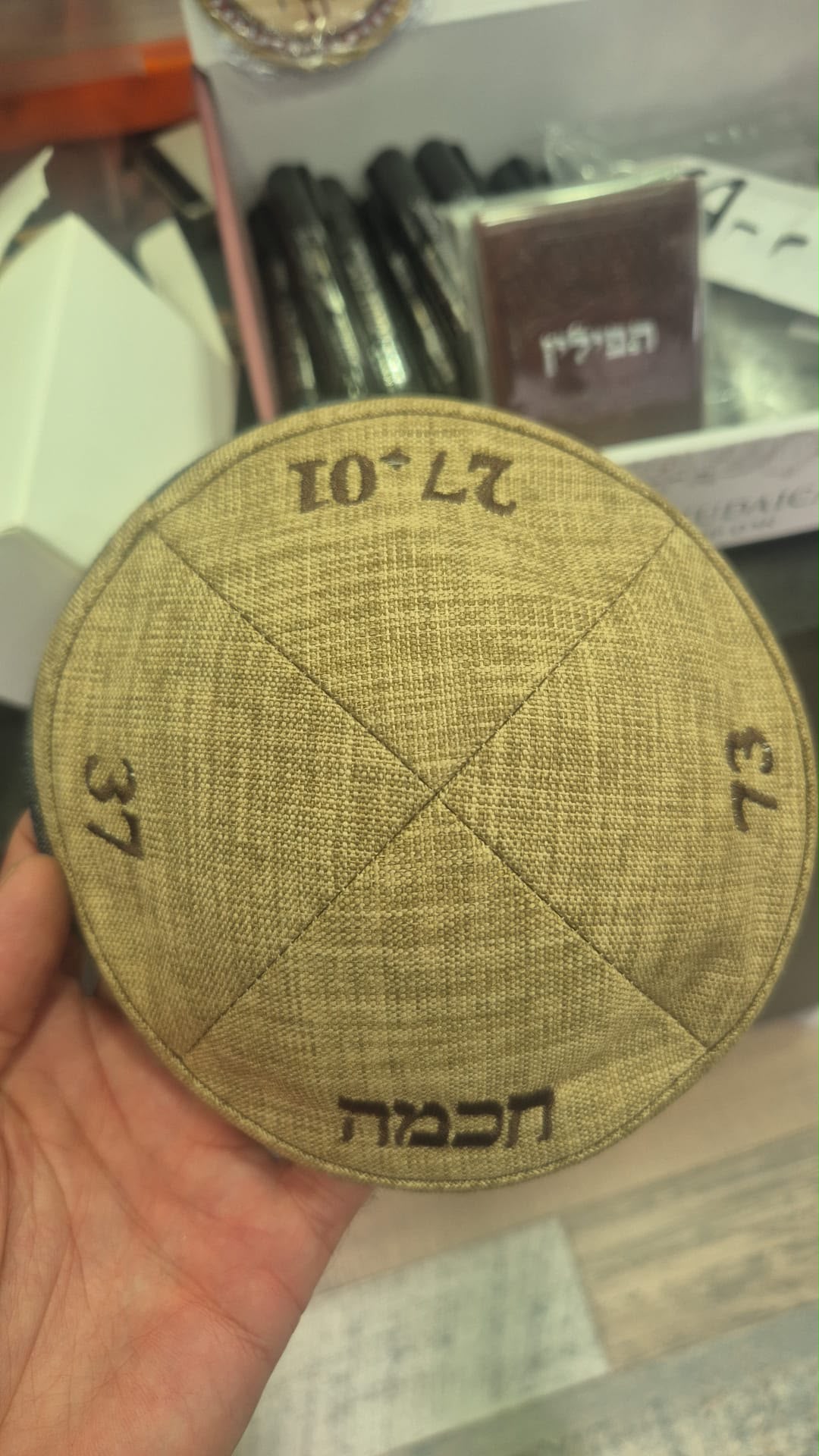
Idan showed me two kippahs (skullcaps) on which he had requested that 1297 and 2701 be embroidered. The two numbers on the kippahs are examined here in relation to a question about the meaning of the kippah, a sentence written immediately afterward, and Idan’s identity. According to the case documentation, in the conversation before the measurement phrases were formulated and the calculation was performed, I told Idan that the kippah expressed the higher power within him. In other words, the higher power was explicitly mentioned in the conversation before the phrases ‘מה זה כיפה’ (‘What is a kippah?’) and ‘הכוח העליון שקיים בעידן’ (‘The higher power that exists within Idan’) were written, and before their Hebrew gematria values and the closure were checked. A closure is a permitted calculation that reaches its specified target exactly.
01Visual source — the two kippahs
Idan showed me two kippahs on which he had requested that the numbers 1297 and 2701 be embroidered. These are the two source numbers used in this finding. The photographs show the kippahs and their embroidered numbers.
02Chronology
The order matters because it separates what already existed from what was formulated and tested later.
03Anchor map — the number, its meaning and its source
These are the five anchors of the direct closure. The first two numbers come from the kippahs Idan presented; the other three are the Hebrew gematria values of the complete phrases shown here.
Identity anchors used below
Distinguishing source inputs from results: 1404 is the difference between the kippah numbers. 574, 148 and 38 are intermediate results obtained through the operations shown below; they are not additional anchors introduced from outside.
04The direct closure
The anchors in the closure: 2701 = the number on Idan’s second kippah; 1297 = the number on his first kippah. On the textual side: 172 = ‘מה זה כיפה’ (‘What is a kippah?’); 806 = ‘הכוח העליון שקיים בעידן’ (‘The higher power that exists within Idan’); 426 = ‘עידן הרפז’ (‘Idan Harpaz’).
04BThrough 574 — a reciprocal return to the names Eran and Idan
Starting point: 2701 is the number on Idan’s second kippah; 1297 is the number on his first. The difference already calculated is 2701 − 1297 = 1404.
A shared node for both calculation routes
1978 is Idan’s birth year. Subtract 1404, the difference between the two numbers on the kippahs, from it:
574 is the result of this subtraction, not an additional external anchor. The following two calculation routes begin from it.
First calculation route — from Idan’s full name to ‘ערן’ (‘Eran’)
426 = ‘עידן הרפז’ (‘Idan Harpaz’), the owner of both kippahs. Subtract the value of his full name from the node 574:
148 is the intermediate result. Add 172 = ‘מה זה כיפה’ (‘What is a kippah?’), the same question formulated after the conversation:
320 = ‘ערן’ (‘Eran’) — the first name of Eran, the other participant in the conversation.
Second calculation route — from Eran’s full name to ‘עידן’ (‘Idan’)
612 = ‘ערן הרפז’ (‘Eran Harpaz’). Subtract that same node, 574, derived from Idan’s birth year and the difference between the kippah numbers, from the value of Eran’s full name:
38 is the intermediate result. Subtract it from 172 = ‘מה זה כיפה’ (‘What is a kippah?’), the very same question:
134 = ‘עידן’ (‘Idan’) — the first name of Idan, the owner of both kippahs.
Supplementary branch — both birth years return to apartment number 58
The same 1404 is the difference between 2701, the number on Idan’s second kippah, and 1297, the number on his first kippah. Subtract it from each birth year: 1982 is Eran’s birth year, and 1978 is Idan’s birth year.
In parallel, the result already encountered at the shared node appears again: 1978 − 1404 = 574.
578 and 574 are intermediate results from the two birth years, not anchors selected from outside.
From 1152 subtract the two full names: 612 = ‘ערן הרפז’ (‘Eran Harpaz’) and 426 = ‘עידן הרפז’ (‘Idan Harpaz’). This gives the intermediate result 114:
Finally, use the same question from the main closure, 172 = ‘מה זה כיפה’ (‘What is a kippah?’). The direction of subtraction matters:
58 is Eran’s apartment number, a fixed personal anchor defined in advance in the RTM system. This is the branch’s target, not the gematria result of a new word.
The apartment branch adds to the network’s density: Both birth years, both full names and the same question lead from the same difference between the kippahs back to another personal target fixed in advance — 58. The branch shares anchors with the two calculation routes above and therefore belongs to the same connected finding.
This is a structurally strong closure, with a reciprocal return to the identities within the same network. The two calculation routes are connected: they share 574, the question value 172, and the surname ‘הרפז’ (‘Harpaz’) within the full names. They are not presented as two statistically independent tests, and no new probability is calculated for them here.
05Why is this structure interesting?
The physical side
2701 is the number on Idan’s second kippah; 1297 is the number on his first kippah. The difference between them is 1404.
The semantic side
‘מה זה כיפה’ (‘What is a kippah?’) = 172; ‘הכוח העליון שקיים בעידן’ (‘The higher power that exists within Idan’) = 806; ‘עידן הרפז’ (‘Idan Harpaz’) = 426. Together: 172 + 806 + 426 = 1404.
06Assessing rarity — what does the number mean in plain language?
Reminder of the control’s anchors: 2701 = the number on Idan’s second kippah; 1297 = the number on his first kippah; 426 = ‘עידן הרפז’ (‘Idan Harpaz’). 172 = ‘מה זה כיפה’ (‘What is a kippah?’) and 806 = ‘הכוח העליון שקיים בעידן’ (‘The higher power that exists within Idan’) are the two original text values. X and Y represent the alternative values in the control described below.
To avoid giving the finding a retrospective advantage, the analysis begins with a very conservative test: both kippah numbers and Idan’s identity are held fixed, while two alternative text values are randomly drawn from the range 1–5000. To match the original structure, the two alternative values must complete exactly the same numerical gap.
The numerical baseline
- Approximately 1 in 25,589 for obtaining the direct arithmetic closure under this conditional null model.
- This number tests only the mathematical requirement: two alternative text values must sum to exactly 978.
- It adds no ‘bonus’ for the fact that 2701 and 1297 were already inscribed on the two kippahs.
Working estimate for the whole finding
- Order of magnitude: hundreds of thousands to millions.
- Central conservative working range: approximately 1 in 500,000 to 1 in 1,000,000.
- This is a sensitivity estimate for the whole finding, not a directly measured final p-value.
Because a null-model alternative must do more than ‘find two numbers whose sum fits.’ It must reproduce the structure jointly: a question formulated once about the kippah; a sentence written immediately afterward that fits the idea of the higher power within Idan; a conversation preceding calculation in which the same semantic connection had already appeared; and finally an exact return to 426 — ‘עידן הרפז’ (‘Idan Harpaz’), the person who owns both kippahs. Requiring the same null-model alternative to satisfy more constraints simultaneously reduces the number of matching alternatives.