Documented cases in which the source record exists before the calculation. Each case presents the source, fixed anchors, closures and the relevant controls.
Research and editorial: Eran Harpaz · RTM — Reflective Time Model
How to read the findings
Each case begins with a documented source record — a screenshot, message, time, date or source text — and only then presents the anchors and calculations. This keeps a clear separation between what already existed and what was derived during the analysis.
Visual sources are shown as documented; sensitive details may be blurred without changing the data fields used in the calculation.
1 · Documented sourceScreenshot, message, time, date or source text.
2 · Fixed anchorsIdentities, dates and background facts that existed before the calculation.
3 · ClosuresThe numerical relations found between fields of the case.
4 · ControlsWhere available — null models, simulations or robustness checks.
1
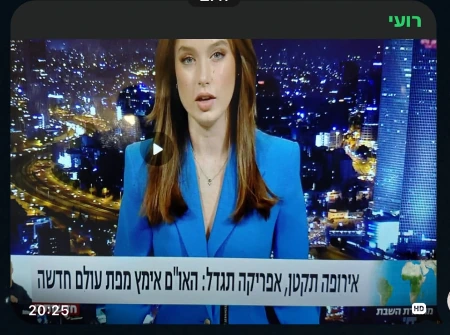
News headline + sender identity ↔ 20:25 — two closures
A news screenshot sent by Roi · the same three source values close in both directions
Authentic real-time message · sender unaware of the later numerical analysis
20:25
Source image: the Hebrew headline and the time 20:25 are visible in the screenshot.
Visible in the screenshot:„אירופה תקטן, אפריקה תגדל: האו״ם אימץ מפת עולם חדשה”“Europe will shrink, Africa will grow: the UN adopts a new world map.”Recorded send time: 20:25.Fixed fact:Sender identity: Roi Harpaz.Derived in calculation:Headline value = 2870 · Roi Harpaz = 578 · 20:25 → 2025.
Two closures
The same three source values — headline, sender identity and time — form two complementary closures: the first returns the recorded time, while the second returns the original headline value.
Closure 1 · Headline value + sender identity → recorded time
2870 → 1447„אלפיים שמונה מאות ושבעים” — Hebrew number words for 2870 = 1447.
Closure 2 · Headline + time − sender identity → headline value
2870 + 2025 = 4895Headline value + recorded timestamp.
4895 − 578 = 4317Subtract Roi Harpaz = 578.
4317 → 2870„ארבעת אלפים שלוש מאות ושבע עשרה” — the Hebrew full-number wording of 4317 has gematria 2870, returning exactly to the original headline value.
The same source values close in both directions: 2870 → 20:25, while the second route uses 20:25 + sender identity to return through 4317 to 2870.
2
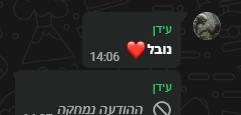
14:06 — “Nobel,” the timestamp, and the sender identity close back on one another
Authentic real-time message · content and timestamp are visible in the source image
14:06
Source image: a message from Idan containing „נובל” (“Nobel”) with the 14:06 timestamp.
Visible in the screenshot:Sender: Idan · recorded message time: 14:06.„נובל ❤️”Fixed anchors:Idan's birth year: 1978 · 292 = „הרפז” is a pre-existing fixed anchor and the surname shared by Eran and Idan · „עידן הרפז” = 426 · „ערן הרפז” = 612.Derived in calculation:„נובל” = 88. In the relevant routes, the documented timestamp 14:06 is verbalized as „שתיים ושש דקות” = 1876; every additional numerical representation is shown explicitly inside the route where it is used.
5 linked closures · strongest first
The routes are ordered by structural directness: first, paths that return the sender identity or the visible message content from source fields and fixed anchors; then representation-based consistency loops. They belong to one network and are not treated as independent statistical trials.
Anchor map for the “Nobel” case
These fields are sufficient to read all five routes without having to track unexplained numbers.
14:06 → 1406Recorded source timestamp.
„שתיים ושש דקות” = 1876The verbal rendering used for the documented 14:06 timestamp in the relevant routes.
„נובל” = 88Visible message content.
1978Idan's birth year.
292 = „הרפז”Pre-existing fixed anchor — the Harpaz surname shared by Eran Harpaz and Idan Harpaz.
426 = „עידן הרפז”Sender identity.
612 = „ערן הרפז”Observer-identity anchor used in the loop route.
Closure 1 · birth year + message time → Idan Harpaz
14:06 → „שתיים ושש דקות” = 1876Verbal rendering of the same documented 14:06 timestamp.
1978 − 1876 = 102Birth year minus the value of the verbal rendering of the 14:06 timestamp.
102 + 102 = 204Doubling the resulting node.
292 − 204 = 8888 = „נובל” — the word visible in the message.
What closes?The birth year, the same timestamp and the family-name anchor return the message content itself.
Source fields:14:06 and „נובל” are visible in the screenshot; 1978 is Idan’s fixed birth year, and 292 = „הרפז” is a pre-existing fixed anchor — the surname shared by Eran and Idan.
1437 − 802 = 635The timestamp and message content converge on 635.
635 → 2087„שש מאות שלושים וחמש” = 2087.
292 → 2087„מאתיים תשעים ושתיים” = 2087; 292 = „הרפז”, a pre-existing fixed anchor and the surname shared by Eran and Idan. The two number-word forms meet at the same value.
Closure 5 · time loop through the observer anchor → back to 14:06
14:06 → „שתיים ושש דקות” = 1876Verbal rendering of the same documented 14:06 timestamp.
2002 + 1782 − 2378 = 14061406 = 14:06 — return to the original timestamp.
The same source record closes in several roles: 426 = Idan Harpaz is reached by two routes, 88 = „נובל” is reconstructed from identity/time anchors, another route connects the timestamp and message content to 292 = „הרפז” through 2087, and a final representation loop returns to 14:06. The five routes are presented as one linked network, not as five independent tests.
3
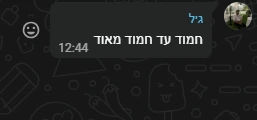
Two representation routes → the same time, 12:44
The same two source values read in two different numerical forms
Authentic real-time message · sender unaware of the later numerical analysis
12:44
Source image: Gil's message „חמוד עד חמוד מאוד” at 12:44.
Visible in the screenshot:„חמוד עד חמוד מאוד”“Cute to very cute.”Recorded send time: 12:44.Fixed fact:„הרפז” (Harpaz) is the family surname shared by the sender, Gil Harpaz, and Eran Harpaz.Derived in calculation:Message value = 241 · „הרפז” = 292.
Cross-representation closure
The two source values are 241 for the message and 292 for the surname „הרפז” (Harpaz), shared by Gil Harpaz and Eran Harpaz. The same pair is then verbalized in two different ways, and both routes produce the difference 1244.
Route A · full Hebrew number wording
241 → 843„מאתיים ארבעים ואחד” = 843.
292 → 2087„מאתיים תשעים ושתיים” = 2087.
2087 − 843 = 1244Returns to 12:44.
Route B · Hebrew digit-by-digit reading
241 → 1046„שתיים ארבע אחד” = 1046.
292 → 2290„שתיים תשע שתיים” = 2290.
2290 − 1046 = 1244The same return to 12:44.
Two different representation rules applied to the same source pair converge on the same recorded time: 12:44.
4
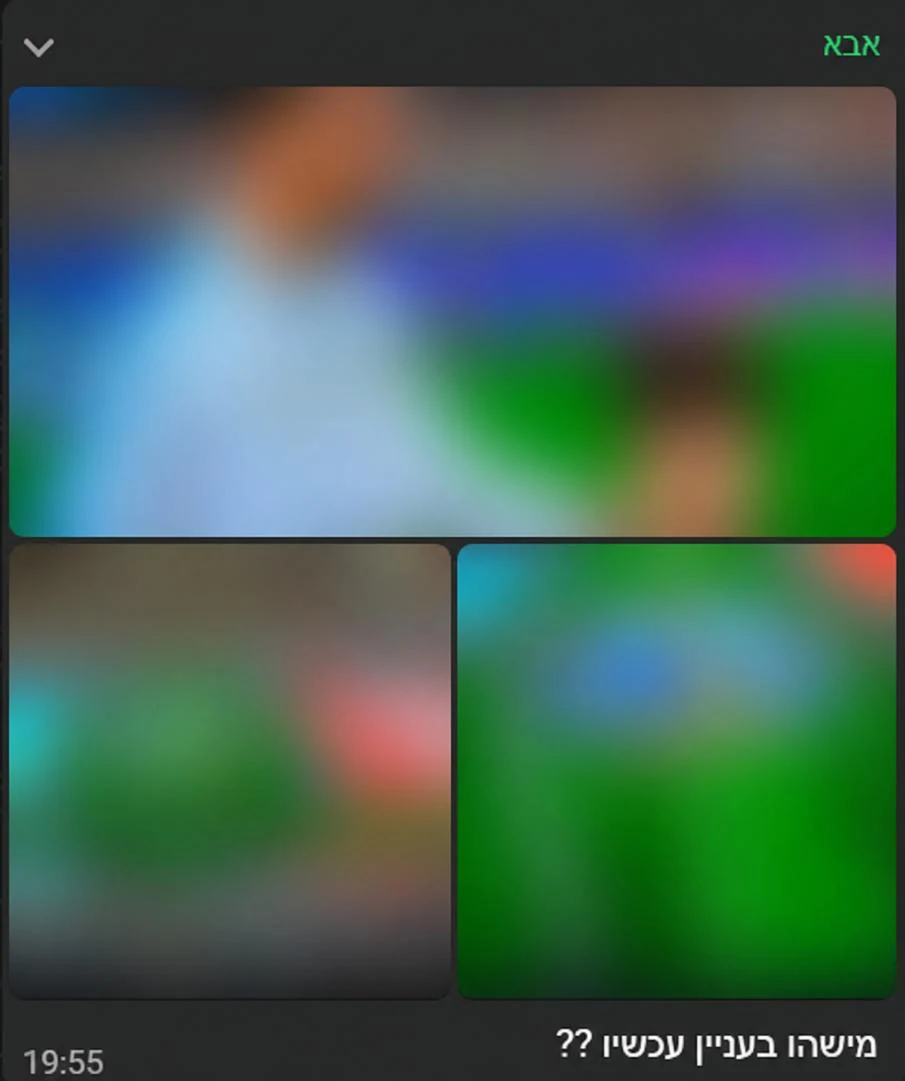
19:55 — an earlier record, a later result, and returns to frozen anchors
Amir Harpaz · family WhatsApp message · Argentina–Austria · 2026 World Cup
Spontaneous real-time event · the message and timestamp predate knowledge of the final score
19:55
Part of the complete 2026 World Cup findingThis page presents the 19:55 core and several later bridges. The complete World Cup dossier contains additional time records, F01, F02, the Spain layer and extended controls.
Source image: Amir Harpaz's WhatsApp message at 19:55. The timestamp and message text belong to the earlier record.
What happened:On 22 June 2026, Amir Harpaz — Eran's father — sent a message in the family WhatsApp group asking who wanted to watch the Argentina–Austria World Cup match. It was sent at 19:55, before the final score was known. The match later ended Argentina 2–0 Austria.Visible in the screenshot:„מישהו בעניין עכשיו ??”Sender: Amir · timestamp: 19:55.Not selected after the fact:58 is Eran Harpaz's apartment number and a fixed, pre-frozen RTM identity anchor. 543 is “Amir Harpaz,” and 251 is “Amir.” These are fixed identity anchors, not targets chosen after the match.
DIRECT CORE
The documented time and the later result meet at the same value
19:55 → 7:55 PM„שבע וחמישים וחמש דקות” = 1650
=
result learned later„שתיים אפס לארגנטינה על אוסטריה” = 1650
1650 = 1650. No arithmetic operation is applied between the two sides. The timestamp itself is frozen in the screenshot; 1650 is the gematria of the natural Hebrew rendering of that same time in 12-hour form.
Source-record and result anchors
Only the fields needed to understand the 22 June record and the later 2–0 result are shown here. Spain-extension anchors are kept separate below.
19:55 → 1955Original WhatsApp timestamp.
„שבע וחמישים וחמש דקות” = 1650Hebrew wording of 7:55 PM, the same time in 12-hour form.
„מישהו בעניין עכשיו” = 959Amir's earlier message text.
58Apartment number — a fixed, pre-frozen RTM identity anchor.
„חמש שמונה” = 749Digit-by-digit wording of 58.
„דירה מספר חמישים ושמונה” = 1414Full apartment-number phrase.
„שתיים אפס” = 901The later 2–0 score.
„שתיים אפס לארגנטינה על אוסטריה” = 1650Full wording of the later result.
22.06 → 2206Source-event date.
Amir = 251 · Amir Harpaz = 543Identity of the message sender.
EARLIER RECORD → LATER RESULT
The central point is not a search for a convenient time after the fact. A frozen WhatsApp record already contains a sender, message text and timestamp. Only later does the 2–0 result become known. The following closures use those documentary fields and pre-existing anchors.
Closure 1 · Earlier time = full later result
19:55 → 7:55 PMSame timestamp in 12-hour form.
„שבע וחמישים וחמש דקות” = 1650Gematria of the natural Hebrew rendering of the documented 7:55 time.
„שתיים אפס לארגנטינה על אוסטריה” = 1650Value of the full result wording known only later.
The equality1650 = 1650. There is no arithmetic operation between the time phrase and the full result phrase.
Why chronology mattersThe 19:55 timestamp is frozen in the screenshot before the 2–0 score is known.
Closure 2 · Message text + apartment anchor → 2–0
„מישהו בעניין עכשיו” = 959Frozen earlier message text.
58Apartment number — a fixed RTM anchor frozen before this case.
959 − 58 = 901901 = „שתיים אפס” — exact return to the later score.
Closure 3 · A second route from the time to the same 2–0
„שבע וחמישים וחמש דקות” = 1650Gematria of the same natural Hebrew rendering of the documented time.
„חמש שמונה” = 749Digit-by-digit wording of the same frozen apartment anchor 58.
1650 − 749 = 901Again, 901 = „שתיים אפס”.
Why this adds informationThe same later target, 901, is reached from both the 959 message field and the 1650 time field through two different routes using the same frozen apartment anchor.
What is not claimedThe routes are not treated as independent statistical experiments; they are components of one event architecture.
Closure 4 · Source date − timestamp → Amir, the sender
22.06 → 2206Date of the source message.
19:55 → 1955Original timestamp of that same message.
2206 − 1955 = 251251 = “Amir” — the sender's first name.
Why this is a core closureBoth inputs are hard documentary fields from the same source record — date and time — and both predate the match result. Their difference returns the sender identity directly.
Statistical statusThis closure is part of the F01 architecture and is not treated as an independent statistical experiment.
Later continuation of the same finding — after Spain wonChronological extension layer
After the champion and official final date were known, the later fields were tested against the earlier 22 June WhatsApp record. The separation keeps the chronology explicit: what was frozen in real time versus what entered only after the tournament ended.
2134Declared Hebrew tournament-title value already active in the earlier World Cup network.
Spain = 344The later champion identity.
19 July → 197The official final-day code.
Closure 5 · Frozen time + Spain + final date → full apartment anchor
Method status: this is an additional relation derived in the later layer from values already documented in the network. It is not part of the original F01 Null audit and is not presented as a prediction recorded before Spain's win.
Closure 6 · Earlier message + Spain → Amir Harpaz, the sender
2206 − 2134 = 72Source date minus the declared tournament-title value.
959 − 72 − 344 = 543Father's message minus node 72 and Spain.
543 = “Amir Harpaz”Return to the identity of the original message sender.
Method status: this route is registered in the Spain network as Spain-07. It also belongs to the later extension, so it is not counted as independent pre-result evidence.
What the controls show — and what they do not show
Exact finite F01 role space1 / 1,306,368,000One full solution occurs among 1,306,368,000 legal numeric role states in the frozen F01 role space. This is finite-space enumeration, not multiplication of closure probabilities.
Search-aware V42 / 100,000Under the neighborhood null, where a random world may search for an alternative architecture within the frozen grammar, 2 of 100,000 worlds meet all Pareto thresholds simultaneously; three other Null families yield 0/100,000.
Structured / de-targeted stress0 / 10,000,000No full exceedance was observed in any tested condition; the conditional one-sided 95% upper bound is p < 2.996×10⁻⁷, less than about 1 in 3.34 million per tested condition.
Negative control: generic arithmetic densityp ≈ 0.640Generic relation density by itself is common. The anomaly claim is therefore about the joint role/chronology architecture, not the fact that equations can be found.
Deterministic auditThe F01 registry contains 24 closure bands, 38/38 equality checks and 25/25 Hebrew-gematria checks; the later audit clarifies 23 informative + 1 invariant in the legacy Null evaluator.
Interpretive boundaryEach number belongs to its declared reference model. They are not multiplied into a universal probability of history. Their purpose is to test whether the structure remains unusual as more search freedom is granted to the Null.
In one sentence: first there is a WhatsApp record containing Amir, 19:55 and message value 959; only later does the 2–0 result occur. The natural Hebrew rendering of the documented time and the full later result meet directly at 1650, and two further routes return to 901 = “two-zero” using the pre-frozen apartment anchor 58. The two hard documentary fields of the record itself — 22.06 → 2206 and 19:55 → 1955 — also close directly on 251 = Amir, the sender. After Spain won, a separate continuation layer returns the earlier 19:55 and message field to 1414 — the full apartment phrase and 543 — Amir Harpaz.
This is only a small part of the complete World Cup finding
Continue to the full dossier, book and video series
This page is designed to present the 19:55 finding as a self-contained case. It does not exhaust the complete 2026 World Cup network, which includes additional time records, F01, F02, Spain, further closures and extended controls.
Authentic real-time message · sender unaware of the later numerical analysis
12:02
Source image: Gil's Hebrew message with the 12:02 timestamp.
Visible in the screenshot:„תראה, אני בטח לא רוצה להרפות את ידייך באומרי שלדעתי זה אינו מדע.”“Look, I certainly don't want to discourage you by saying that, in my opinion, this isn't science.”Sender: Gil · recorded time: 12:02.Fixed fact:Sender identity: Gil Harpaz.Derived in calculation:Message value = 3460 · Gil Harpaz = 335.
Numerical closure
The message value and the sender identity form a short chain that returns to the message time.
3460 − 2123 = 1337This creates the intermediate node 1337.
1337 → 2258„אלף שלוש מאות שלושים ושבע” = 2258.
3460 − 2258 = 12021202 → 12:02, the timestamp visible in the source.
The chain returns exactly to 12:02, the recorded message time.
6
20:06 — Pre-specified live test (request frozen in advance): one sentence about Gil’s father → 3 closures
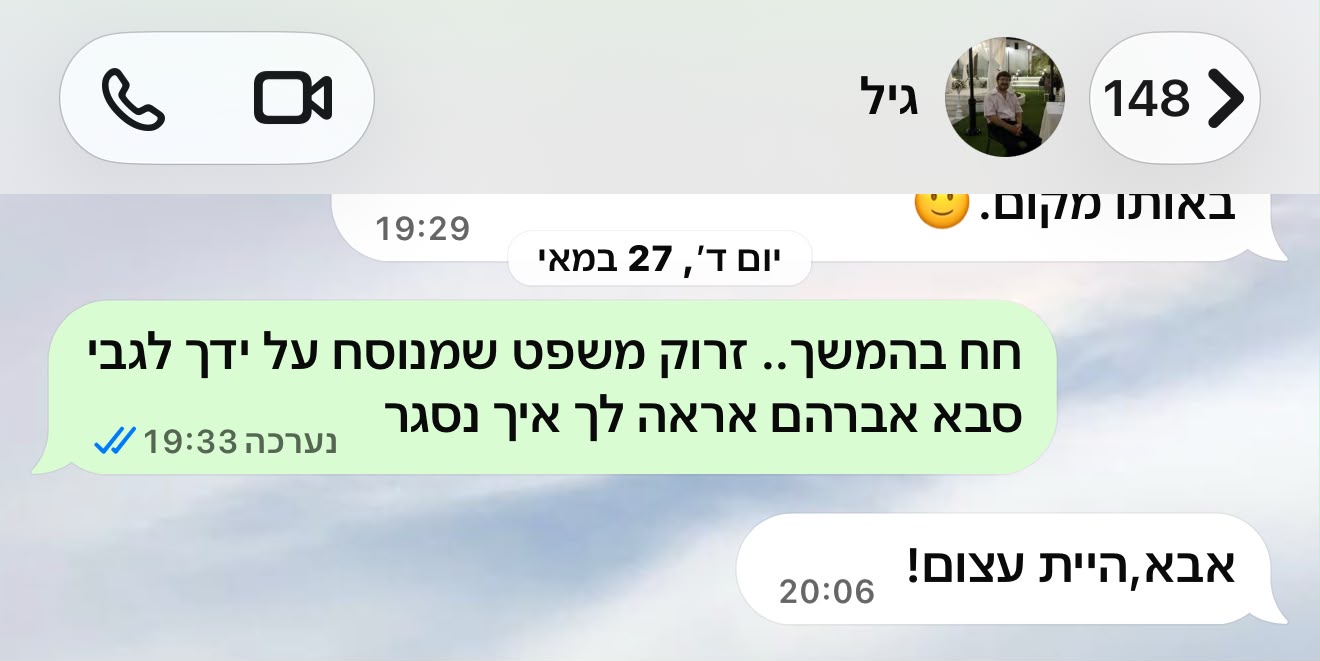
The request was fixed in advance: Gil was asked to write one sentence about his father, Abraham Harpaz — Eran’s grandfather
Pre-specified live test · no numerical target or dictated wording
20:06
Source image: the Hebrew sentence and the 20:06 timestamp appear together in the screenshot.
Visible in the screenshot:The chat header identifies Gil. At 19:33 he is asked, in Hebrew, to “write a sentence phrased by you about Grandpa Abraham; I’ll show you how it closes.” At 20:06 his reply appears:„אבא, היית עצום!”“Father, you were tremendous!”Fixed in advance:The participant is Gil; the subject is his father Abraham Harpaz — Eran Harpaz's grandfather; and the request to produce his own sentence appears in the screenshot before the reply.Derived in calculation:The reply = 635 · 20:06 → 2006.
Pre-specified live test · request frozen in advance · 3 closures
One externally produced response enters an already established family-data field and yields three separate closures: to Eran Harpaz, to the Harpaz surname, and to a reflexive loop that returns exactly to the documented 20:06 timestamp.
Closure 1 · Timestamp and sentence return Eran Harpaz
20:06 → 2006The recorded timestamp.
Inputs: 635 | 540 | 56 | 47 | 116635 = the sentence; 540 = Abraham Harpaz; 56 = his age at death; 47 = 1979→2026 residue; 116 = pre-existing RTM constant.
What closes?The writer starts as 231, passes through two representations and fixed event anchors, and the equation returns exactly to 231 = Yosef Cohen.
Structural pointThis is an identity loop: writer → representations + event anchors → the same writer.
Closure 2 · The sentence returns the family surname
635 → 2087„שש מאות שלושים וחמש” = 2087.
292 → 2087„מאתיים תשעים ושתיים” = 2087.
2087 ↔ 2087 ⇒ 292292 = „הרפז” (Harpaz), the surname shared by Abraham, Gil and Eran.
Closure 3 · Time loop: 20:06 returns to itself through the message and sender identity
2006 → 792„אלפיים ושישה” (“two thousand and six”) = 792.
1762 → 2006„אלף שבע מאות שישים ושניים” (“one thousand seven hundred sixty-two”) = 2006 → an exact return to the recorded 20:06 timestamp.
Within the same live test, the sentence “Father, you were tremendous!” and the recorded time 20:06 participate in three closures: 612 = Eran Harpaz, 292 = Harpaz, and a reflexive timestamp loop 20:06 → 2006 → 792 → 1762 → 2006 → 20:06.
7
Yosef Cohen — „ערן עדיף תורה” → 5 linked closures
Yosi, a member of the WhatsApp group in which Eran Harpaz participates, spontaneously changed the group name to „ערן עדיף תורה”. Eran is the person referred to by the new group name and the person who performed the numerical measurement and analysis afterward.
Spontaneous event · no numerical target or prior request
WhatsApp
Source image: the WhatsApp system notice records that Yosi changed the group name and that its new name is „ערן עדיף תורה”.
Who is who in the event:Yosi (Yosef Cohen) is a member of the WhatsApp group. Eran Harpaz is another group participant and the person referred to by the new group name „ערן עדיף תורה”. After the name change, Eran performed the numerical measurement and analysis. This is why the values for Yosef Cohen, Eran Harpaz, Harpaz and Eran’s age are treated as identity anchors belonging to the same event rather than names introduced from outside the event afterward.What the screenshot directly records:„שם הקבוצה השתנה על ידי יוסי ועכשיו היא נקראת ‘ערן עדיף תורה’”“The group name was changed by Yosi and is now called ‘Eran Adif Torah’.”Event anchors fixed before calculation:
Yosef Cohen231
Eran Harpaz612
Harpaz292
Eran’s age at the event44
Number key used in the closures below:
„ערן עדיף תורה”1095
The question „מי רשם את המשפט ערן עדיף תורה”2520
Digit reversal of 2520: 0252 → 252252
231 read digit-by-digit: „שתיים שלוש אחת”1805
231 as a full Hebrew number: „מאתיים שלושים ואחת”1602
2520 as a full Hebrew number: „אלפיים חמש מאות עשרים”1586
252 as a full Hebrew number: „מאתיים חמישים ושתיים”1675
This key is for readability only; each closure below also repeats the meaning of the values it uses.
5 linked closures
The case is not a single numerical match. Five closures reuse event data and representations created in earlier steps, repeatedly returning to 231 = Yosef Cohen and 292 = Harpaz.
Closure 1 · Full identity loop — return to Yosef Cohen
231 → 1805„שתיים שלוש אחת” = 1805.
231 → 1602„מאתיים שלושים ואחת” = 1602.
1805 + 1602 − 2520 − 612 − 44 = 2312520 = the event question; 612 = Eran Harpaz; 44 = age. The result returns to 231 = Yosef Cohen.
Closure 2 · Sentence and question meet through digit reversal
Documented Null checks · reported separately by model
p ≈ 8.97×10⁻¹³Empirical model with observed lengths: about 1 in 1.115 trillion.
≈ 1 / 3.06TBroader empirical model without length conditioning.
≈ 1 / 72BSmall aggressive verbal Null documented in the consolidated report.
0 / 1,120,422Permutation over 1,059 Knesset members: zero ordered pairs satisfied S2–S5 together within the tested positive-content range.
These values are not pooled into one p-value: each row belongs to a different Null model. Local/strict models reach trillion-to-one scales; estimates decrease when the allowed search freedom is broadened.
The five verified arithmetic closures form a linked network that returns twice to 231 = Yosef Cohen and twice to 292 = Harpaz, while moving through the group-name phrase, the event question, digit reversal and Hebrew number representations. The exact rarity estimate depends on the Null model, so the controls are reported separately rather than as one universal probability.
Method note: this page documents the structure and chronology of the findings. Rarity estimates are assessed separately with Null models matched to the search space of each case.